Newsbeat

Target Audience
The target audience for newsbeat is for a younger audience on BBC 1 as they have gathered around eight million 16-14 year old and has a total of 8-14 million views online through articles, videos and social media as they have adapted to modern technology in order to survive and approach younger audiences.
Content
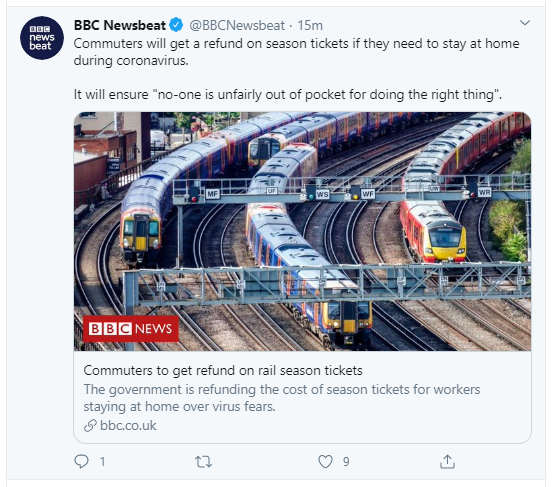
Founded in 1973, BBC Newsbeat mainly focuses on stories that will affect younger audiences such as public transport new (as shown above) on social media which is important for promotion for younger audiences as formats like this will easily get the youth viewing these stories. However, I know that BBC is funded by a licence what is paid by the UK citizens meaning the BBC’s main intentions are to offer diverse content instead of gaining an audience. Newsbeat has been created to fit the criteria of content for younger audiences with modern views such as LGBT+ as this community has been mentioned many times through their news feed.
The Today Programme

Target Audience
Contrasting to Newsbeat, The Today Programme’s Target is focused on ages 35 and over as it is broadcasted on BBC 4 with an audience of 7 million in 2019 also through an online article, BBC sounds as they have also adapted to modern technology to reach to more people and become more accessible.
Content

Founded in 1957, Radio 4 focuses on going into detail as their purpose is to broadcast factual programmes featuring common themes of solutions and more civilised debate as it mainly attracts an audience of 35+. From above, you can see a broadcast on BBC Radio 4 – Today as a Cambridge professor invites Jacob Rees-Mogg (member of Parliament) to a ‘naked debate’ about Brexit. I believe that this content fits the target audience of BBC Radio 4 due to the matured and factual content which may not interest a younger audience. The Today Programme has been created to fit the criteria of delivering factual and informative content to an older audience without being too left-wing or too right-wing.
Lauren Laverne

Lauren Laverne is a 41 year old DJ for BBC Radio 6 Music and was a lead singer and additional guitarist in the rock band Kenickie. I believe that Lauren is a good choice for BBC Radio 6 as she has been brought up in a council estate area and still has her accent from where she is from so audiences may feel more connected with her as she understands her audience and has lived their lifestyle also.
Cross-platform Marketing

Cross-platform marketing is advertising strategy as your website/radio is able to run on multiple types of computer systems, enabling it to become more accessible to your audience. Radio stations such as BBC has used this strategy such as creating a website and a app which included videos, radio stations and games for their diverse audience in order to attract a younger audience.
Conventions of a Speech based Programming

Presenter : acts as the anchor to guide the discussion between guests.
Discussions : a group of people discussing a range of topics.
Phone-ins : effective cheap way of involving the listeners.
Contributors : new magazine programmes such as Late Night Woman’s Hour has high brow guests including writers, artists and academics.
Drama : Radio 4 has a regular feature of The Afternoon Play. Other dramas include long running soaps.
Documentaries : May be related to news items or current affairs. Music themed about the life of the musician or celebrity.
Scheduling

Content
Late Night Woman’s Include content for a matured audience as it includes topics such as pregnancy’s, break-up’s and mortgages and includes the conventions of ; discussions, phone-ins an contributors who discuss their problems or help others with their problems which link to the topic.
Ofcom

The Communications Act in 2003 established Ofcom as the new Uk regulator.
Role of Ofcom
- To ensure a wide range of televisions and radio services of high quality and wide appeal is available.
- To maintain plurality in the provision of broadcasting.
- To adequately protect audiences against harmful material.
- To protect audiences against unfairness of infringement of privacy.
Stuart Hall’s Reception Theory

Stuart Hall asserted that communication is a process encoding by producers and decoding by audiences. He said that there are three ways in which messages and meanings may be decoding by audiences.
The dominant position : the audience accepts the intended meaning of the encoded in the product.
The negotiated reading : the audiences acknowledges some of the messages encoded by the producers of the product but may question or adapt the message to be more relatable to their own experiences.
The oppositional reading : the encoder’s message is understood, but the decoder disagrees with it.
Curran and Seaton

Media producers are controlled by a small number of companies primarily driven by the logic of profit and power. The idea that media concentration generally limits or inhibits variety, creativity and quality. The idea that more socially diverse patterns of ownership help to create the conditions for more varied and adventurous patters of ownership.
 Home
Home 